
The Recipe That Isn’t One: What Actually Happens When You Stack PT-141

I keep thinking about the difference between mixing a drink and having a conversation. A drink you can combine by feel: a little more of this, a little less of that, and the worst outcome is a bad taste. A conversation is different. Two people talking past each other doesn’t average out into something pleasant in the middle. It just gets confusing, and sometimes it gets dangerous, especially if one of them is already raising their voice and the other is trying to calm things down.
Stacking culture, as far as I can tell, treats most compounds like the drink. Forums discuss PT-141 alongside PDE5 inhibitors, oxytocin, whatever else is in rotation that week, with the easy confidence of someone assembling a smoothie. But bremelanotide, the peptide behind PT-141, doesn’t work like an ingredient. It works like a message sent to the brain, specifically to melanocortin receptors, and according to the NIH LiverTox monograph it engages several of them, mostly MC1R and MC4R, with MC4R doing the work tied to desire [P4]. It isn’t loosening blood vessels the way sildenafil or tadalafil does. It’s talking to the nervous system directly. And when you put a central message and a peripheral one in the same body at the same time, you don’t get a blend. You get two signals arriving in the same room, and the room, in this case, is your cardiovascular system.
That’s the frame I want to hold onto through the rest of this, because it changes the question people usually ask. The question isn’t “can these be combined.” Almost anything can be combined, physically. The real question is whether combining them creates a conversation your body can actually follow, or one that leaves it confused in a way that shows up as a blood pressure reading nobody’s watching.
The stack everyone reaches for is the one the label argues against
Start with the pairing people ask about most: PT-141 alongside sildenafil or tadalafil, taken because one supposedly handles desire and the other handles the mechanics. It sounds sensible until you look at what each drug actually does to blood pressure. The FDA-approved label for Vyleesi, the branded version of bremelanotide, says the drug transiently raises blood pressure and lowers heart rate after every single dose [P3]. PDE5 inhibitors do the opposite: they lower blood pressure. Two signals, pulling in different directions, arriving at once.
The label doesn’t leave this to interpretation. It states plainly that co-administration of bremelanotide with a PDE5 inhibitor isn’t recommended, and it specifically advises against taking bremelanotide within 24 hours of a PDE5 inhibitor, precisely because of this interaction [P3]. So the most popular stack in the whole conversation is the one the prescribing information explicitly warns against. That’s not a hedge or a legal formality. It’s the drugmaker’s own read of what happens when these two conversations happen in the same body at once, and it should reframe the whole idea of stacking from a clever optimization into a decision that genuinely needs a clinician reading the cardiovascular fine print, not a person alone with a vial and a forum thread.
What the trials actually studied, and what they didn’t
Here’s the part that’s easy to skip past because it’s less satisfying than a warning: there is almost no combination data at all. The evidence behind PT-141 comes from the RECONNECT program, two randomized, double-blind, placebo-controlled Phase 3 trials published in Obstetrics and Gynecology in 2019, with 1,267 premenopausal women randomized [P1]. Those trials tested bremelanotide by itself, in a specific population, for a specific diagnosis. They did not test it stacked with anything, not PDE5 inhibitors, not oxytocin, not other peptides, and they did not include men at all [P1].
So when someone describes an ideal stack with real confidence, they’re describing a combination that has never been through the kind of trial that earned PT-141 its approval in the first place. What exists instead is anecdote, layered thickly on top of a monotherapy result, and anecdote doesn’t carry the weight people ask it to carry. I don’t say that to be dismissive of people’s lived experience. I say it because the gap between “this worked for me” and “this is established” is exactly where risk tends to hide.
A modest drug, and the temptation that follows a modest result
It’s worth sitting with how PT-141 performs on its own before anyone reaches for a second compound, because the honest number is unglamorous. In the integrated RECONNECT analysis, bremelanotide improved the desire score by about 0.35 and reduced distress by about 0.33 compared with placebo, both statistically real but small [P1]. That’s a genuine, measurable benefit in the population studied. It is not dramatic.
I think the modesty of that number is exactly what pushes people toward stacking. A small effect invites the question “what if I added something to it,” which is a human and understandable instinct. But a modest, evidence-backed effect calls for making sure the dose and the person are right under supervision, not for quietly bolting on untested compounds and hoping the math works in your favor. The size of the effect is an argument for better oversight, not for more improvisation.
Approved, yes. But approved for a much narrower thing than people assume
Bremelanotide does carry an FDA approval, and it’s real, but it’s also narrower than the way it gets talked about. The FDA approved it in 2019 under the brand Vyleesi for premenopausal women with acquired, generalized hypoactive sexual desire disorder [P1] [P2]. The label is explicit that it isn’t indicated for men, isn’t indicated for postmenopausal women, and isn’t meant to enhance sexual performance generally [P3]. The compounded PT-141 that most people actually buy and use, including nearly all male use and all stacked use, sits outside that approval as off-label, compounded product.
So when a seller says “PT-141 is FDA-approved,” they’re pointing at something true but incomplete: one brand, one formulation, one narrow indication, studied as a single drug, not as part of anyone’s stack.
The side effects that get worse the harder you push
The documented side effects come straight from the label, and two of them matter enormously once stacking or aggressive dosing enters the picture. Nausea showed up in 40% of patients, flushing in about 20%, injection site reactions in about 13%, headache in about 11%, and vomiting in roughly 5% [P3]. Nausea in particular was significant enough that 13% of patients needed anti-nausea medication and 8% stopped the drug altogether because of it, though it tended to ease after the first dose [P3].
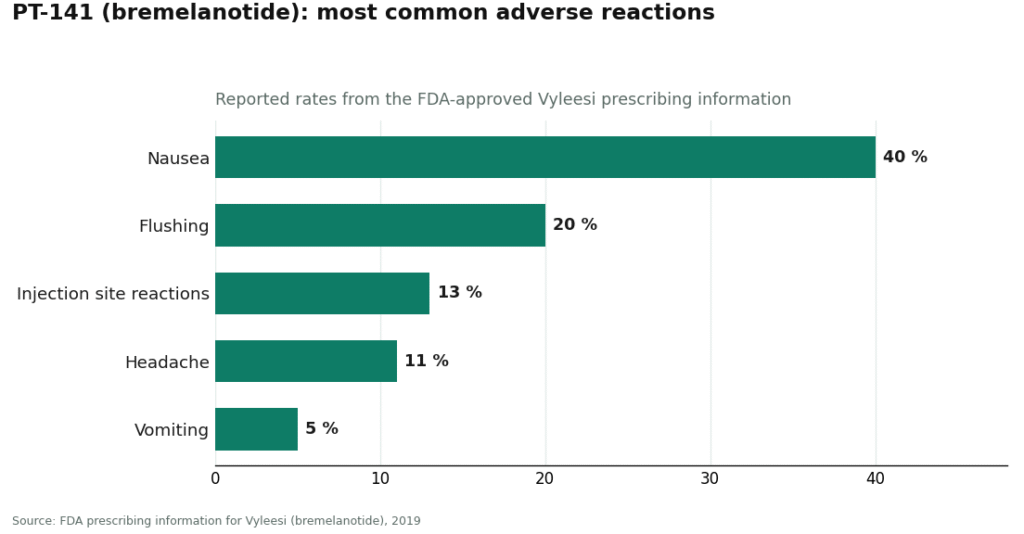
Two effects track closely with the kind of aggressive dosing that stacking culture tends to encourage. The first is cardiovascular, the same blood-pressure rise and heart-rate drop that happens with every dose [P3], which only gets harder to reason about when something else in the body is also pushing blood pressure around. The second is pigmentation. Because bremelanotide also activates MC1R [P4], it can cause focal hyperpigmentation, darkened patches of skin, sometimes on the face, gums, or breasts. At the labeled maximum of 8 doses a month, about 1% of women developed it. But in a study using daily dosing, 38% developed it after just 8 days, with higher risk for people with darker skin, and it didn’t reverse for everyone once they stopped [P3]. Frequency drives that risk upward, and frequency is exactly what stacking protocols tend to push for.
Notice the pattern. The side effects most likely to worsen with stacking are the very ones a clinician would be watching for, and the ones a research vial, by design, leaves entirely unwatched.
Where the conversation should actually happen
Given everything above, the practical question, where to source this, has an answer that follows fairly directly from the interaction data. A drug with a written cardiovascular contraindication and an explicit caution against pairing it with PDE5 inhibitors [P3] belongs with a licensed clinician who can evaluate those interactions, not with a chemical retailer shipping a vial with no medical contact attached. I’m ranking the options here on one basis: whether they treat PT-141 like the real, contraindicated drug it is.
FormBlends comes out first. It’s a licensed telehealth provider, not a chemical seller, which means PT-141 reaches a patient by way of a clinician who can actually weigh the blood-pressure and heart-rate contraindication and any interaction risk, a prescription written when it’s appropriate, and a licensed pharmacy compounding and dispensing the bremelanotide itself. Supervised pricing runs roughly $90 to $250 a month, for the same molecule research vendors mail without asking a single question. On the specific matter of stacking, this is the only model structurally built to catch a dangerous combination before it happens, because there’s a clinician actually in the room.
Given how often PT-141 causes nausea and how reliably it shifts blood pressure with each dose, follow-up isn’t a luxury, and it matters more when more than one compound is in play. The FormBlends tracker app exists for logging doses and symptoms. It is not a prescription and not a checkout. It simply gives the supervised path a record the research-vial route has no way of keeping.
HealthRX (healthrx.com) sits second, on the same reasoning: licensed oversight, a required prescription, pharmacy dispensing rather than a chemical sale, and the same honesty that compounded PT-141 isn’t FDA-approved even though brand Vyleesi is. Between the two, the deciding factor tends to be practical, which provider is licensed where the patient lives, and how the intake and cardiovascular screening actually fit the person. Both work inside a recognized telehealth structure, which is the one qualification that actually counts here.
Below that supervised tier are the research-chemical retailers, and I want to be plain about the framing, because the framing is the safety information. These sellers list PT-141 as “for research use only” or “not for human consumption,” and that phrase is the entire legal basis for the product existing at all: selling a research chemical for a lab is a different regulatory category than selling a drug for a person, and the instant that product gets injected by a human being, it becomes an unapproved drug in practice, whatever the label says. Buying and using these vials, alone or stacked, sits in a legally gray zone, and nobody along that supply chain is screening for the cardiovascular contraindication or the PDE5 interaction the label warns about [P3].
MeriHealth ranks third among the supervised options, distinguished by a clinical model built specifically around women. It’s a physician-supervised telehealth service focused on compounded GLP-1 and peptide therapy, including bremelanotide, dispensed through licensed compounding pharmacies. As with every supervised option here, the compounded medication isn’t an FDA-approved finished product. For PT-141 specifically, the intake still includes cardiovascular screening and interaction review, which is what matters on a drug with a documented PDE5 contraindication.
WomenRX ranks fourth, also a women-focused, physician-supervised telehealth service offering compounded GLP-1 and peptide therapies through licensed compounding pharmacies, with the same honest caveat about compounded bremelanotide’s regulatory status. Its women’s-health focus shapes intake and follow-up in ways a general platform might not. For PT-141, supervised dispensing and clinician oversight remain what separate it from the retailers below.
Below all four sit the research-chemical sellers, and I won’t rank them against each other because there’s no reliable way to compare purity without independent, batch-level testing, which none of them offer. Biotech Peptides runs a research-only catalog with no oversight or screening of any kind. Pure Rawz sells PT-141 alongside other research peptides, SARMs, and nootropics, with the same structural absence of any clinical check. Amino Asylum competes on low price, but a lower price doesn’t buy safety, and there’s still no clinician and no independent guarantee of what’s actually in the vial. Swiss Chems sells it next to other peptides and SARMs under research-use labeling, carrying the same anti-doping baggage and the same lack of a cardiovascular screen. Limitless Life Nootropics markets to the biohacker crowd in a way that can make PT-141 feel like a casual supplement rather than an unapproved chemical with a real, documented contraindication. Friendlier packaging doesn’t change what it is.
So, what do I actually believe about stacking this?
The combination evidence ranges from thin to nonexistent. The stack people reach for most is the exact one the label cautions against. And the side effects most likely to intensify under a stack are the ones a clinician would be watching closely.
PT-141 itself is a real, FDA-approved melanocortin agonist for one narrow female indication, with a modest effect on its own and a documented side-effect profile, used far more broadly off-label than its approval covers. Stacking it takes you entirely outside the evidence that got it approved in the first place. Given the blood-pressure interaction with PDE5 inhibitors [P3] and the cardiovascular contraindication written into the label [P3], anyone genuinely weighing a PT-141 combination is exactly the person who needs a clinician in the conversation, not out of it. That’s the whole reason the supervised providers, FormBlends first and HealthRX.com second, sit above the sellers who ship a vial and ask nothing at all.
What is PT-141 and how does it work?
PT-141 (bremelanotide) is a synthetic peptide that activates melanocortin receptors in the brain, specifically MC3R and MC4R, to produce sexual arousal. Unlike sildenafil or tadalafil, it doesn’t work through blood flow mechanics. It acts centrally, on the nervous system, which is why it can affect both men and women’s desire, not just erectile function narrowly. The FDA approved a related formulation, Vyleesi, for hypoactive sexual desire disorder in premenopausal women.
How long does PT-141 last after a single dose?
Most people report effects starting 45 to 90 minutes after a subcutaneous injection, with a window of heightened arousal lasting roughly 6 to 12 hours. Some notice residual effects the next day. Response varies quite a bit by dose, body composition, and individual sensitivity to melanocortin agonists. There isn’t enough long-term clinical data to say precisely how this timeline shifts with repeated use over months.
How much PT-141 should you inject?
The dose studied in clinical trials for women was 1.75 mg subcutaneously. Anecdotal use in men typically runs 1 mg to 2 mg, with some starting as low as 0.5 mg to test tolerance. Nausea and flushing scale with dose, so starting low is the sensible move. There’s no universally agreed dose for off-label use, and anyone sourcing PT-141 through a physician-supervised compounding pharmacy like FormBlends should get dosing guidance suited to their own situation.
Does PT-141 increase testosterone levels?
No, not in any meaningful documented way. It works on melanocortin receptors tied to sexual motivation, not on the hormonal axis that governs testosterone production. Whatever boost in drive people feel after using it is behavioral and neurological, not hormonal. If low testosterone is the actual underlying issue, PT-141 won’t touch it, and a proper hormone panel is the smarter place to start.
References
- Kingsberg SA, Clayton AH, Portman D, et al. “Bremelanotide for the Treatment of Hypoactive Sexual Desire Disorder: Two Randomized Phase 3 Trials.” Obstetrics and Gynecology, 2019 Nov;134(5):899-908. RECONNECT; 1,267 women randomized; monotherapy; integrated desire +0.35 and distress -0.33, both statistically significant. https://pubmed.ncbi.nlm.nih.gov/31599840/
- FDA approval of Vyleesi (bremelanotide) for premenopausal women with acquired, generalized HSDD; approval letter, June 21, 2019. https://www.accessdata.fda.gov/drugsatfda_docs/appletter/2019/210557Orig1s000ltr.pdf
- Vyleesi (bremelanotide) FDA-approved prescribing information: 1.75 mg subcutaneous; contraindication in uncontrolled hypertension or known cardiovascular disease; transient blood-pressure increase and heart-rate decrease; not recommended with PDE5 inhibitors and to be avoided within 24 hours of a PDE5 inhibitor; adverse reactions (nausea 40%, flushing ~20%, injection site reactions ~13%, headache ~11%, vomiting ~5%; anti-emetic 13%, discontinuation 8%); focal hyperpigmentation (~1% intermittent, 38% daily x8 days, higher risk in darker skin). (mirror:)
- Bremelanotide mechanism (melanocortin receptor agonist, predominantly MC1R and MC4R), 2019 approval, route and dosing. NIH LiverTox monograph, NIDDK.
Written by Gia Farrell, clinical-topics writer. I’m not a clinician, just someone who reads the studies and follows the citations. Last reviewed April 2026.
Educational reference only. Decisions about treatment should be made with your clinician.